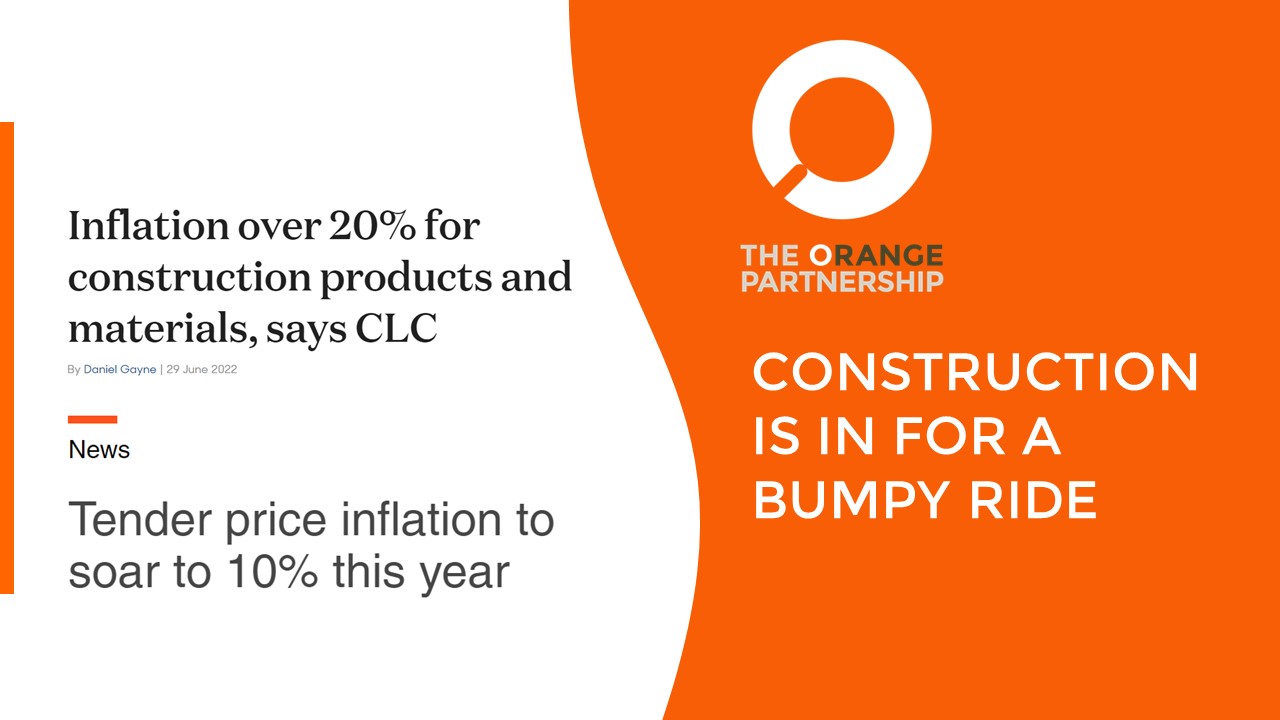
Current indicators for inflation in the construction industry are increasingly worrying. Latest estimates are that tender prices are forecast to grow 8-10% year on year and annual Producer Price Inflation (factory buy in prices) reached a record high of 24.1% in June 2022.
Not surprisingly we are seeing more and more requests to help clients understand inflation issues on their projects.
NEC Contracts are excellent at driving collaborative client and supply chain relationships. Clients and contractors who are well governed and work together in an open and transparent manner with good project management skills will be best placed to deal with the challenges ahead. A robust understanding of inflation risk and targeted procurement strategies and interventions will help all parties minimise the unwanted cost of inflation. But there will be a cost, and ultimately clients will need to consider this in future budget setting plans.
Project Managers may increasingly look to help from assurance providers. This could be in terms of:
- Assessing the true value of escalating costs – we are seeing claims or simple refusals to supply goods on some of our biggest projects
- Assuring compliance with contract procurement procedures to make sure value is driven in a difficult market. Excessive inflation is a tough cross to bear for most clients. The pain can be exaggerated and particularly difficult to take if its contractor is making a fee on inflation growth under an Option E contract
Assuring Plant and Material costs
Now more than ever, Clause 52.1 of NEC contracts will be tested with respect to Plant and Material costs incurred on projects. Clients will place more and more emphasis on whether monies spent are at “open market or competitively tendered prices”.
The whole project team will feel pressure. Procurement and risk managers will do what they can to mitigate issues (whether price or supply availability or supply chain insolvency), whereas programme and project managers will have to deal with scheduling and financial fall out. Finance and Audit will ask all the obvious questions but is the project team ready for these questions?
Audit approaches may be more obtrusive than ever.
Be Prepared
If you are involved in a major contract, there are a few basic things you are probably already doing:
- Review and understand fully your contract
Revisit exactly what price review mechanisms exist in your contracts. Think about your supply chain, what you/they buy and whether these inflation provisions are sufficient
- Revisit your risk register and project finance
Make sure inflation is adequately logged, priced and discussed at all risk meetings. Openly discuss issues with your contractor and its key supply chain partners. Work through scenarios and potential impacts on project budgets
- Understand wider stakeholder expectations
Regardless of whether projects are public or private funded, there is usually someone “upstairs” that has expectations on value for money and cost growth management. Re-engage with these stakeholders to ensure they guide you on what their expectations are on hyper-inflation issues. We see many contracts with threats of Cabinet office, National Audit Office, Audit Comptroller type review, yet rarely do project teams know what these people may challenge or want to see demonstrated. Understand what might they want to see?
- A collaborative plan
Now is the time to plan ahead, working with the project team to make sure appropriate checks and balances are in place day to day to give confidence in costs. These checks should be continuously in place throughout the project journey and fully compliant with contract expectations.
- Consider an independent review early on
No one wants the nasty surprise of an audit team being dropped in at the end of projects investigating cost hikes. The risk of disallowed costs may be high if key procurement procedures haven’t been followed and/or costs can’t easily be demonstrated to be value for money. An independent review early on will help ensure appropriate checks and compliance is in place.
Where a client relies too much on in-house teams, there is a risk that the people doing the checking may, “go native”. This is particularly a risk in longer term relationships.
Understand cost growth claims at a granular level
When you open the door to price re-negotiation or escalation don’t be naïve. Suppliers should be willing to fully demonstrate in an open book environment the true cost of elemental cost growth in their products or services. We regularly see “claimed figures” way in excess of what is actually needed or accurately supported.
To find out more about The Orange Partnership approach or for a confidential chat about a potential issue please get in touch.
Darren Ward FCA, AQ – Managing Director
darrenward@theorangepartnership.co.uk