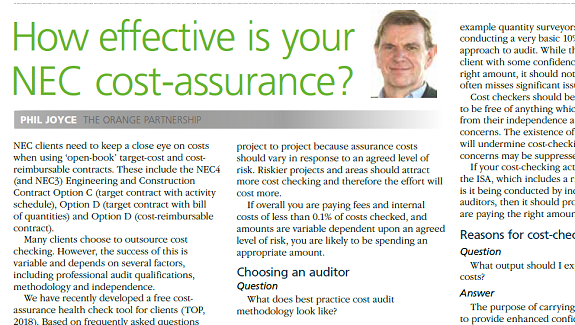
We were delighted to be asked to contribute an article on cost-assurance to the NEC users’ group newsletter (January 2019). The full text of the article is included below:

How effective is your NEC cost-assurance provision?
NEC clients need to keep a close eye on costs when using ‘open-book’ target-cost and cost-reimbursable contracts. These include the NEC4 (and NEC3) Engineering and Construction Contract Option C (target contract with activity schedule), Option D (target contract with bill of quantities) and Option E (cost-reimbursable contract).
Many clients choose to outsource cost checking. The success of this is variable and depends upon many factors including; professional audit qualifications, methodology and independence.
We have recently developed a free cost-assurance health check tool for clients (TOP, 2018). Based on frequently asked questions from our NEC clients in the nuclear, defence, water and transport sectors, it intended to be a simple health-check for NEC users to self-assess how effective their current cost-assurance provision is.
The most frequently asked questions are as follows.
Cost of cost-checking
How much should I spend on cost checking in open-book contracts?
Answer:
NEC clients on open-book contracts often do not know what they are paying for cost-checking, especially when using generalist auditors. Frequently the amount of money spent on cost checking can be hidden among a basket of activities. So, as a client, the first step is to isolate the cost of cost-checking so you can understand whether you are receiving value for money.
Once you have isolated the cost, in our experience overall you should not be paying more than 0.1% of the value of costs checked. However, in practice this may fluctuate from project to project because assurance costs should vary in response to an agreed level of risk. Riskier projects and areas should attract more cost checking and therefore the effort will cost more.
If overall you are paying fees and internal costs of less than 0.1% of costs checked, and amounts are variable dependent upon an agreed level of risk, you are likely to be spending an appropriate amount.
Choosing an auditor
What does best practice cost audit methodology look like?
Answer:
There are three key criteria a client should look for. First, a formal methodology based on international auditing standards; second, qualified auditors; and third, independence.
To ensure consistency and a meaningful output, there should be a formal methodology which auditors follow. It should demonstrate how the audit work is planned, delivered, recorded, reviewed and reported on. The most robust approach is that set out in the International Standards on Auditing (ISA) (IFAC, 2018), which is accepted as best practice recognised throughout the world.
The methodology incorporates the identification and assessment of risks through understanding the NEC contract and its environment. To be meaningful this can often include a review of your NEC contractor’s accounting system and an in-depth analysis of transactions taken from its accounting systems as well as a review of the contract and structured interviewers with stakeholders.
The standards require a professionally qualified auditor to interpret and apply them. We often see people without appropriate auditing and assurance qualifications, for example quantity surveyors or engineers conducting a very basic 10% substantiation approach to audit. While this may provide a client with some confidence they are paying the right amount, it should not be relied upon and often misses significant issues.
Cost checkers should be free and be seen to be free of anything which may detract from their independence and ability to raise concerns. The existence of conflicts of interest will undermine cost-checking activities as any concerns may be suppressed.
If your cost-checking activity is based upon the ISA, which includes a risk assessment, and is it being conducted by independent, qualified auditors, then it should provide confidence you are paying the right amount.
Reasons for cost-checking
What output should I expect from an audit of costs?
Answer:
The purpose of carrying out cost checking is to provide enhanced confidence or assurance that amounts being charged by your NEC contractor are appropriate. A written report of the scope of work done and any findings backed up with evidence is the basis for delivering enhanced confidence or assurance that amounts charged are appropriate.
Common issues should be discussed and reviewed at senior level. Looking at issues at a programme level, issues which arise consistently across different projects may be identified and dealt with appropriately.
Where an overstatement or understatement is identified, you should always expect to see an explanation for the reason behind that misstatement and the offer of follow-up work to make sure that it will not happen again and that any overcharges have been taken out of future applications.
Potential savings
How much do you generally find?
Answer:
It varies considerably. It depends upon: the competence of your NEC contractor in accounting for costs; the clarity of the NEC contract – often the application of Z clauses can muddy the waters and mean that what constitutes defined costs are not clear; the level of collaboration achieved by the parties; the circumstances of your contractor; who has previously audited the contract and how qualified and effective they were; and the level of risk in the project.
On average we identify overstatement of costs of 0.7%, however this can vary to between 0.1% to 30%.